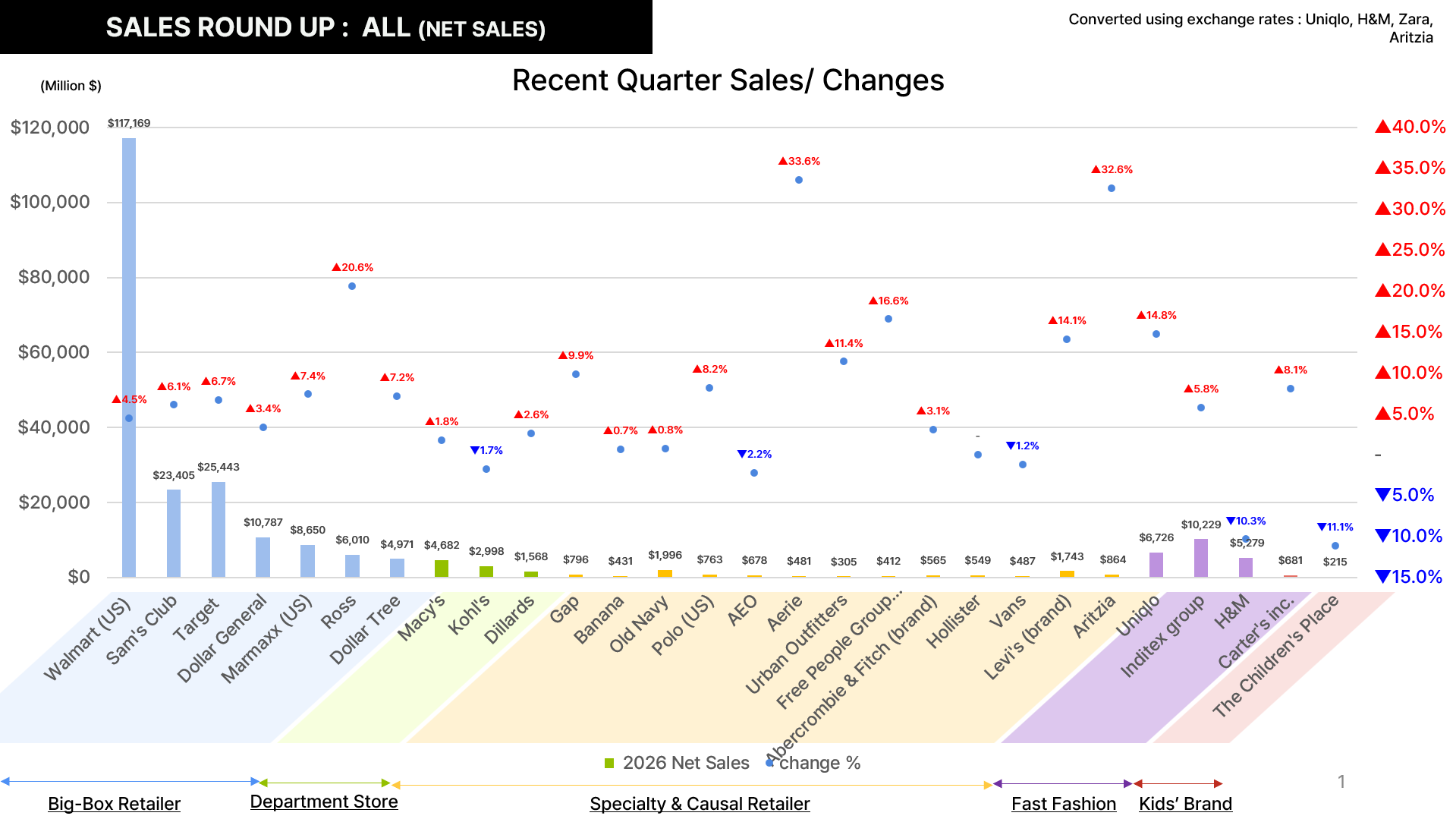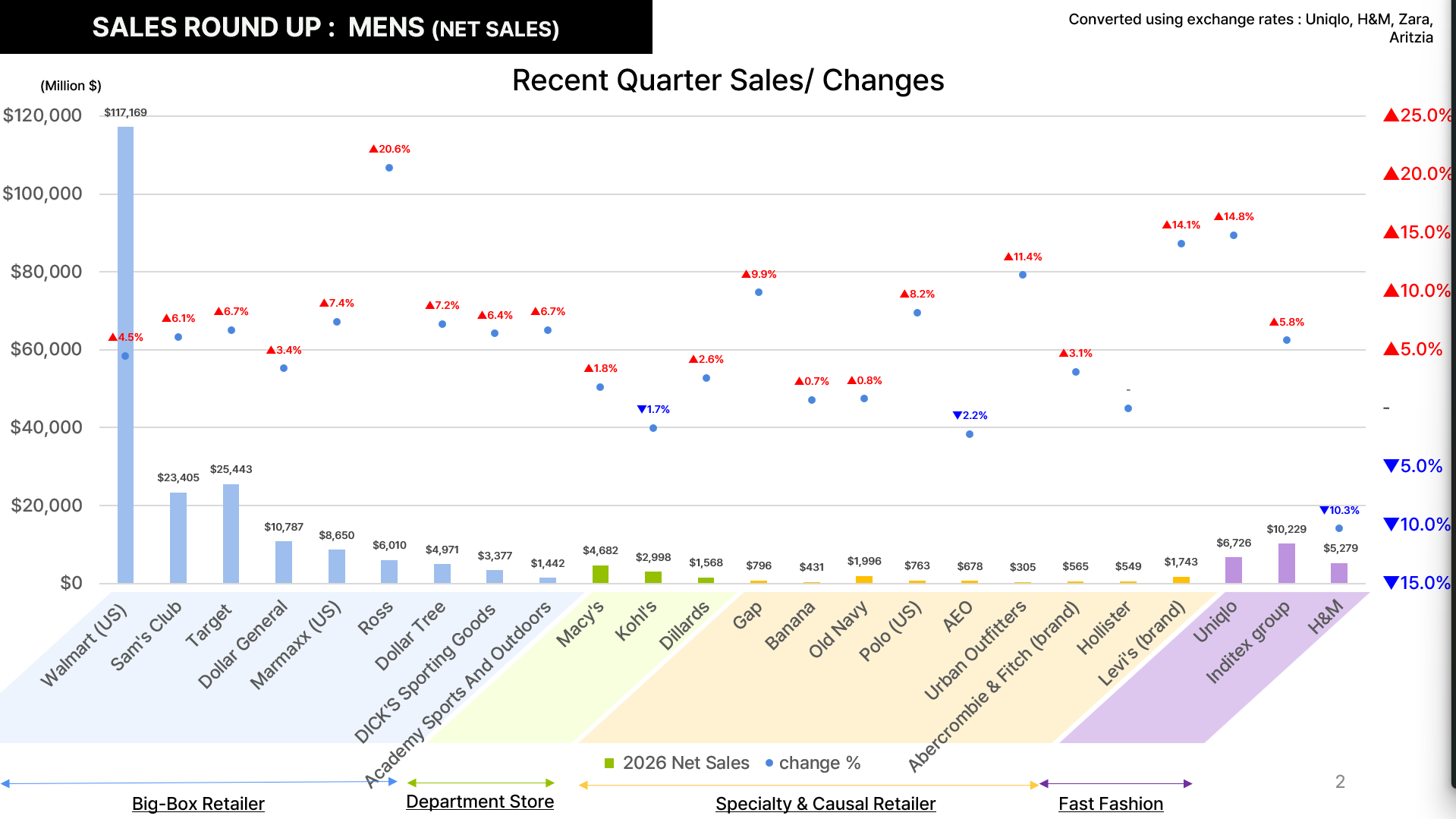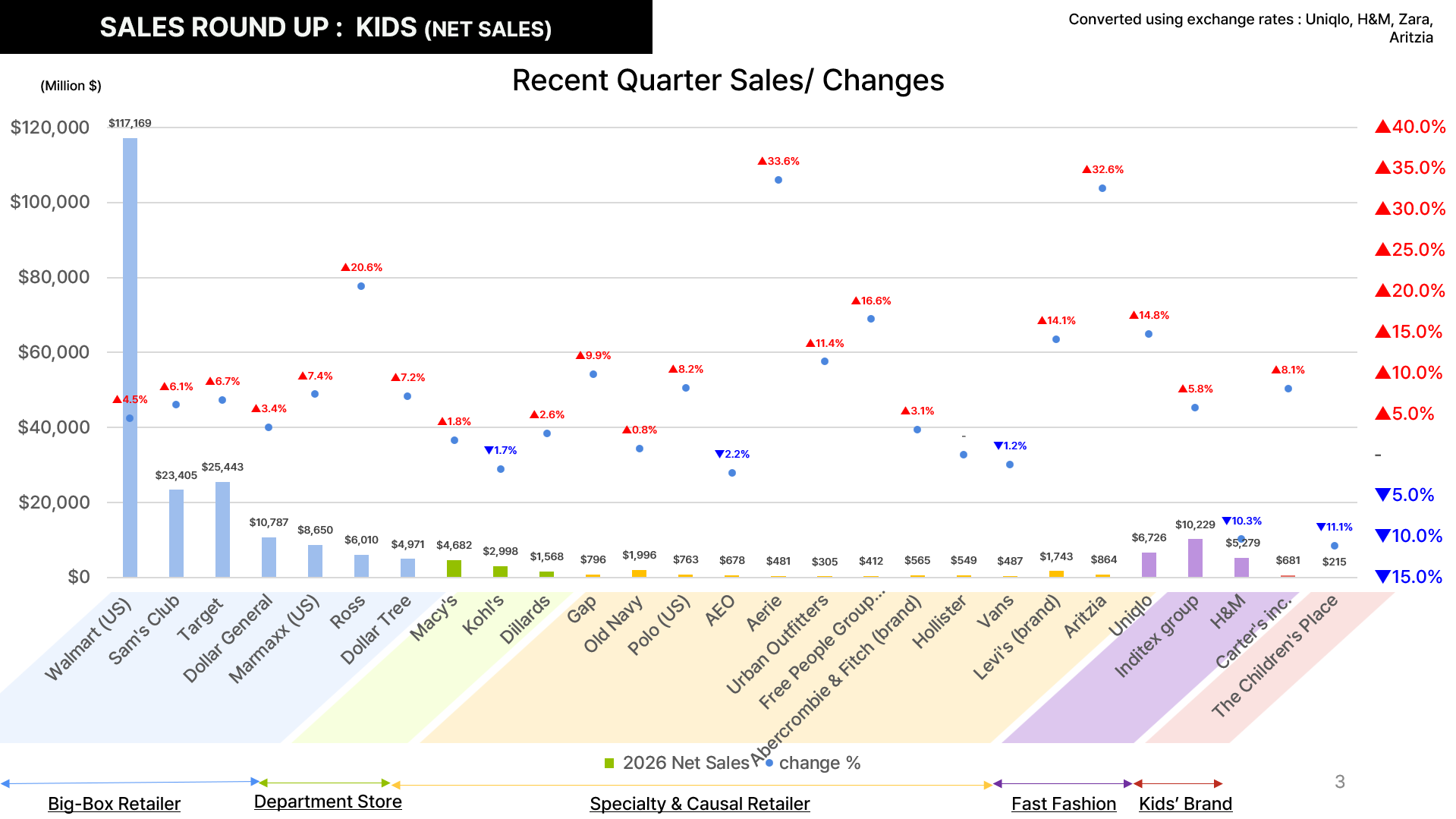
US Retail Sales (Total)
US Retail Sales (Apparel)
| Month | All items | Core CPI | Apparel |
|---|---|---|---|
| 24-Jan | 3.1% | 3.9% | 0.1% |
| 24-Feb | 3.2% | 3.8% | 0.0% |
| 24-Mar | 3.5% | 3.8% | 0.4% |
| 24-Apr | 3.4% | 3.6% | 1.3% |
| 24-May | 3.3% | 3.4% | 0.8% |
| Month | All items | Core CPI | Apparel |
|---|---|---|---|
| 24-Jan | 3.1% | 3.9% | 0.1% |
| 24-Feb | 3.2% | 3.8% | 0.0% |
| 24-Mar | 3.5% | 3.8% | 0.4% |
| 24-Apr | 3.4% | 3.6% | 1.3% |
| 24-May | 3.3% | 3.4% | 0.8% |
Analysis of Private Label Dominance & Sourcing Risks
U.S. consumers are shifting to ultra-rational spending. While May retail sales grew 6.9% YoY, apparel unit volume fell 4.3%, pushing Private Brand (PB) apparel to a record 49% market share.
Value-driven retailers are growing, while premium brands pivot to paid memberships to retain high-income shoppers.
Supply chains face volatile disruptions, including a 20% productivity drop from Cambodian heatwaves and potential sourcing duty spikes of 5% to 12% if the 'First Sale Rule' is abolished.
(June 14, 2026 – July 13, 2026)
(May 10, 2026 – June 13, 2026)
To ease household financial burdens during the Back-to-School season, Kohl's has significantly lowered the starting prices of its private brand children's apparel. Core PB lines like 'Kids' So' and 'Sonoma Goods for Life' now start at just $6.99, while the fall collection of its best-selling activewear PB 'Tek Gear' is priced under $19.99, bringing 85% of all children's clothing under $25. Furthermore, Kohl's has simplified its store layout by introducing a 'Deal Bar' section that integrates national brands (like Nike and Levi's) with private labels by category to enhance intuitive shopping.
Publication Date: July 14, 2026
Source : WWDWalmart and Sam's Club have rolled out substantial price reductions on key summer and fall essential items. Walmart's "Rollback" campaign includes thousands of items across groceries, daily necessities, outdoor goods, toys, and summer fashion apparel. While specific apparel brands and discount margins were not fully disclosed, this preemptive markdown strategy aims to help inflation-weary consumers secure essential goods ahead of the upcoming seasons.
Publication Date: July 14, 2026
Source : Retail DiveFast Retailing, the parent company of Uniqlo, has significantly raised its financial guidance for the 2026 fiscal year following a surprise earnings beat in Q3. The company projects a 16.7% YoY increase in annual revenue and a 28.8% surge in operating profit. The success is largely attributed to its quality-focused 'LifeWear' strategy—featuring summer cooling apparel and fall merino wool—which has firmly established the brand as a strong alternative to premium labels in North America and Europe. Effective supply chain automation and advance bulk purchasing of raw materials also helped defend profit margins.
Publication Date: July 14, 2026
Source : Just StyleGlobal denim icon Levi Strauss & Co. achieved a surprise Q2 earnings beat, driven by an impressive 11% growth in its Direct-to-Consumer (DTC) channels. Empowered by these strong results, Levi's upgraded its full-year 2026 EPS and operating cash flow guidance. The performance was significantly bolstered by successfully capitalizing on the retro casual and "loose-fit" denim trends currently sweeping North America, which noticeably accelerated the inventory turnover of its premium denim lines.
Publication Date: July 14, 2026
Source : Just StylePremium footwear brand 'On' has successfully extended its rapid technological innovation into its apparel division, resulting in an explosive 57.5% surge in Q1 apparel sales. By utilizing its proprietary 'LightSpray' fiber coating technology, the brand launched premium performance tops that perfectly adhere to the skin without needles or threads. High-profile collaborations with cultural icons like Zendaya and luxury brands like Loewe have solidified On's transition from a single-category shoe brand to a high-end sports lifestyle powerhouse.
Publication Date: July 14, 2026
Source : GlossyUltra-low-cost fast fashion giant Primark recorded an explosive 16% YoY growth in cumulative Q3 sales, fueled by its aggressive physical store expansion across the United States. Unlike competitors relying heavily on e-commerce, Primark has strongly adhered to a brick-and-mortar strategy, rapidly eating into the US value apparel market share amidst high inflation. The brand continues to prove the enduring power of physical retail traffic by offering a "treasure hunt" shopping experience.
Publication Date: July 14, 2026
Source : Retail DiveAccording to Deloitte's latest research, overall retail spending during the US Back-to-School season is expected to remain flat, entering a period of stagnation. Factoring out price inflation, actual sales volumes are essentially halted. Diminishing disposable income is causing parents to drastically cut back on discretionary apparel spending, indicating a fiercely competitive and challenging promotional environment for retailers in the second half of the year.
Publication Date: July 14, 2026
Source : Chain Store AgeA 2026 Back-to-School consumer survey reveals that 51% of parents plan to purchase private label (PB) brands over national brands due to cumulative inflation fatigue. Mass merchants offering one-stop shopping, like Walmart and Target, overwhelmingly ranked as the preferred shopping channels, beating out traditional department stores. Furthermore, nearly 25% of consumers are actively defending their budgets by utilizing cashback websites and secondhand platforms, cementing ultra-rational spending as the new normal.
Publication Date: July 14, 2026
Source : Retail DiveTotal sales revenue at US apparel retail stores saw a modest 3.6% year-over-year increase in May. However, this growth is largely an illusion driven by high average selling prices (ASP) due to inflation; the actual physical volume of clothing purchased by consumers significantly decreased. Exhausted by inflation, US shoppers are scaling back their fashion budgets for non-essential items, heavily shifting their spending toward highly versatile basic wear.
Publication Date: July 3, 2026
Source : Just StyleA long-term report projects that the "Value Apparel" sector will outpace the growth rate of the overall global apparel market through 2030. Middle and low-income consumer bases are increasingly gravitating towards affordable, high-quality lifestyle wear brands. This shift provides a massive advantage to large-scale retailers capable of optimizing costs through bulk purchasing, particularly with products that minimize design complexity in favor of core functionality.
Publication Date: July 4, 2026
Source : Just StyleUltra-low-cost fast fashion brand Primark continues its aggressive march across the US, opening state-of-the-art large-format stores with the goal of reaching 50 locations nationwide. Bypassing e-commerce, the brand focuses entirely on maximizing profitability through its physical stores. For the Back-to-School season, Primark has specialized its store layouts to encourage families to bulk-buy essentials, securing rock-bottom prices on basic items like t-shirts through diversified supply chain sourcing.
Publication Date: July 1, 2026
Source : Retail DiveThe earlier timing of Amazon's Prime Day event has essentially pulled forward the Back-to-School apparel shopping race into early July. Parents are actively making early purchases to take advantage of heavy discount chains rather than waiting until late August. Brands that fail to finalize the supply and delivery of their early back-to-school items risk completely missing out on this critical early-season sales peak, which is currently dominated by basic short-sleeve tees and light layered vests.
Publication Date: July 3, 2026
Source : Modern RetailDick's Sporting Goods is launching a new premium paid membership program to strengthen customer retention. By introducing an aggressive $99 annual subscription model, the sports retailer provides members with robust benefits, including perpetual fast free shipping, priority access to exclusive brand collaborations, and invites to free fitness events. This strategy aims to lock in high-income sports enthusiasts and secure stable full-price sales and cash flow despite a broader consumer spending downturn.
Publication Date: July 4, 2026
Source : Retail DiveDigital-first brands are successfully utilizing TikTok Shop as their primary weapon for international expansion. Leading names like Nex Playground, MBX, and Fashionphile have entirely bypassed traditional large-scale offline promotions and retail partnerships. Instead, they leverage TikTok's one-click checkout ecosystem and creator affiliate networks to rapidly penetrate the UK, European, and Japanese markets. By integrating on-demand production processes driven by real-time trend responses, these brands have significantly mitigated excess inventory risks.
Publication Date: June 29, 2026
Source : Vertex AI Search RedirectWhile fashion retailers are aggressively integrating artificial intelligence, they are drawing firm lines to keep core brand elements under human control. Many companies successfully use AI for personalized curation, real-time logistics tracking, and chatbot consultations. However, they actively block AI automation in areas concerning core brand identity, final visual artwork decisions, and strategic overseas vendor negotiations, recognizing that organic emotion and corporate trust relationships remain irreplaceable human assets.
Publication Date: June 25, 2026
Source : Modern RetailH&M achieved improved profitability in Q2 through fixed-cost reductions and supplier cost negotiations, resulting in a meaningful YoY increase in net income. However, the retailer failed to meet customer demand due to overly strict inventory controls. Driven by economic uncertainty, H&M kept its order volumes excessively tight, leading to massive stockouts of key seasonal items in stores. This extreme inventory conservatism paradoxically resulted in missed sales opportunities and a slowdown in top-line growth.
Publication Date: June 25, 2026
Source : Fashion NetworkSaks Global has successfully exited Chapter 11 bankruptcy protection and is relaunching as 'Exemplar Luxury Group.' The restructuring eliminated over 60% of its existing debt, radically improving its financial health. The company is now revamping its retail strategy by permanently closing unprofitable physical stores and transitioning to a heavily optimized omnichannel business model focused on its digital platforms and key flagship locations.
Publication Date: June 26, 2026
Source : WWDPremium athleisure brand Alo Yoga has sold its casual t-shirt division, Bella+Canvas, at a premium valuation to focus entirely on its core wellness brand identity as it prepares for an IPO. The massive cash liquidity secured from the sale will be funneled into expanding its experiential flagship stores, which integrate wellness studios globally. Experts view this as a shrewd business slimming strategy designed to maximize valuation ahead of its upcoming initial public offering.
Publication Date: June 26, 2026
Source : Business of FashionA report from the Food Industry Association (FMI) highlights that value-driven private brands (PB) at large warehouse clubs are rapidly outpacing high-priced national brands. Consumers are responding not just to lower prices, but to high-quality ingredients, sophisticated packaging, and robust retailer trust that rival national brands. Over 92% of shoppers regularly bulk-buy private label products, stating they would continue buying PB even if national brand prices drop, fueled further by viral social media marketing on platforms like TikTok.
Publication Date: June 23, 2026
Source : Grocery DiveAmid widespread inflation fatigue, consumers are migrating en masse to private label (PB) products offered by large retailers. An overwhelming 94% of US adult respondents indicated that exclusively shopping for retailer-owned brands has become their normal routine. Rejecting the premium cost bubbles associated with brand names, this shift to smart, value-maximizing consumption has also significantly elevated the negotiating power of retailers in long-term cost discussions with global manufacturers.
Publication Date: June 23, 2026
Source : MediaPostA forecast for the second half of 2026 indicates that global apparel market growth will be driven by supply chain inflation and resulting price increases (Average Selling Price), rather than an actual increase in consumer demand. Skyrocketing manufacturing costs, fueled by Middle East tensions, freight rate spikes, and raw material inflation, are forcing retailers to pass costs onto consumers. Consequently, consumers are expected to engage in "selective buying," significantly reducing the number of items purchased while focusing on high-quality basics and athleisure.
Publication Date: June 19, 2026
Source : Just StyleUtah and Idaho have rapidly emerged as critical growth markets for retail giants Target and Kroger, as traditional major cities face population saturation and high operating costs. An influx of young, high-income families driven by remote work and tech company relocations has caused the local consumer market to explode. In response, Target has deployed customized, next-generation store layouts that have significantly outperformed initial revenue projections.
Publication Date: June 15, 2026
Source : Modern RetailAccording to the US Census Bureau, May 2026 retail sales reached $763.7 billion, demonstrating robust growth of 0.9% month-over-month and 6.9% year-over-year. The three-month cumulative total from March to May rose by 5.3% YoY, showcasing strong consumer resilience despite inflation fears. The growth was heavily led by non-store (e-commerce) retailers, which surged 12.2% YoY, indicating a cemented trend of consumers shifting away from physical marketplaces to seek better value online.
Publication Date: June 17, 2026
Source : Vertex AI Search RedirectProlonged high inflation and interest rates are driving consumers away from full-price retail and toward deep-discount '260 Sample Sale' events. With unsold premium brand inventory and samples marked down by 70% to 90%, visitor numbers have consistently increased by over 10% year-over-year. A Gartner study notes that "economic value" is now the core priority for consumers, highlighting a strong desire for "smart luxury" where shoppers demand top quality at rational prices.
Publication Date: June 17, 2026
Source : Vertex AI Search RedirectLifestyle retailer Anthropologie is targeting the 'kidult' and digital detox trends by positioning high-end, elegantly designed tabletop board games as flagship items. Following a 19% surge in online searches for board games, the company boldly expanded its relevant SKUs by 34%. By offering home decor and hobby items with longer lifecycles than apparel, Anthropologie is effectively increasing customer dwell time in stores, sparking cross-category purchases to defend overall profit margins.
Publication Date: June 16, 2026
Source : Modern RetailAccording to the latest data from Circana, while overall retail sales rose a slight 1.2% in May, actual unit volume fell by 4.3%, indicating a widespread avoidance of high-priced items. Consequently, private label (PB) apparel has reached a historic milestone, accounting for 49% of the total apparel market revenue. Squeezed by the cost of living, consumers are actively trading down, shunning premium labels for high-quality, reasonably priced retailer private brands.
Publication Date: June 16, 2026
Source : Chain Store AgeDenim-focused brands are successfully overcoming the limitations of e-commerce by expanding their specialized offline stores. Powerhouses like Abercrombie & Fitch and Favorite Daughter are aggressively opening customized locations in key target areas. Because critical purchasing factors such as fabric stretch, detailed fit, and intricate wash patterns require a tactile, in-person fitting evaluation, these experiential physical spaces are directly driving conversions.
Publication Date: June 13, 2026
Source : WWDThe "Blokecore" style, which integrates retro football (soccer) jersey heritage into everyday streetwear, has reached its peak this summer alongside World Cup excitement, according to fashion publication Glossy. Fashion outerwear heavily borrowing details from 90s vintage uniforms—such as light collars, vintage emblems, and bold front sponsorship graphics—is dominating the market. Packaging industries are also lowering costs for sporty, limited-edition jersey boxes to help brands create attractive sets.
Publication Date: June 10, 2026
Source : GlossyAccording to the National Retail Federation (NRF), US Father's Day spending is expected to reach a historic $27.9 billion this year. Moving away from traditional electronics, practical and stylish apparel—such as comfortable golf wear, high-density resort loungewear, and quality linen shirts—dominates, accounting for over 40% of the spending share. The trend is heavily supported by flexible omnichannel shopping behaviors, like reserving mobile gift cards for immediate in-store pickup.
Publication Date: June 10, 2026
Source : NRFExtreme heatwaves exceeding 40°C in Cambodia have devastated local garment manufacturing efficiency, dropping worker productivity by nearly 20%. According to a GIZ (German Agency for International Cooperation) report, the primary causes are the overloading of factory cooling systems and frequent power outages. This has led to critical schedule delays in precision cutting and mass sewing stages, prompting global buyers to urgently diversify their sourcing portfolios to mitigate delivery failure risks.
Publication Date: July 14, 2026
Source : Just StyleFearing the implementation of new US-China geopolitical tariffs this fall, large retailers are engaging in massive front-loading, which is expected to push July US port import volumes to a record high. The NRF and Hackett Associates forecast July imports to exceed 2.47 million TEU. This influx is causing bottlenecks at major ports like Long Beach and New York/New Jersey, driving up inland rail costs by over 15% and forcing retailers to scramble for emergency inland warehousing to avoid crippling demurrage fees.
Publication Date: July 14, 2026
Source : Just StyleRecent data from the Office of Textiles and Apparel (OTEXA) covering January to May shows that US apparel sourcing is moving away from simple low-cost chasing toward highly specialized, value-added diversification. While countries relying purely on cheap labor saw negative growth, nations like Vietnam and Bangladesh grew by 4-6% based on their strengths in precision outdoor and performance apparel. Buyers are now fragmenting their orders to match specific manufacturing capabilities rather than relying on a single factory for all items.
Publication Date: July 14, 2026
Source : Textile TodayShein's on-demand supply chain service, 'Xcelerator', is gaining traction as a breakthrough solution for mid-sized US brands facing stagnant growth. The platform completely resolves the traditional retail defect of 8 to 12-month lead times and the risks of excessive early ordering. By adopting an ultra-fast reactive model that replenishes inventory based on real-time sales data from small initial batches, brands are eliminating dead stock waste and fiercely protecting their final profit margins.
Publication Date: July 14, 2026
Source : WWDSports giant Nike is anticipating a refund of approximately $986 million for overpaid IEEPA tariffs following a US Supreme Court ruling. While the refund will significantly improve Nike's cash flow and net income for the latter half of the year, the company warns that long-term global trade crises remain unresolved. Punitive tariffs continue to be the most threatening factor in determining sourcing costs, and short-term relief in the trade environment is unlikely.
Publication Date: June 30, 2026
Source : Vertex AI Search RedirectThe apparel industry is undergoing a massive shift from traditional manual quality checks to active, data-linked inspection systems. By sharing real-time, unmanned measurement data with partner factories at every step of the process rather than just at final shipment, brands are preemptively reducing internal defect rates by an average of 23%. This evolution transforms the dynamic between brands and vendors from blame-shifting over defects to strategic partnerships focused on joint improvement.
Publication Date: June 26, 2026
Source : Vertex AI Search RedirectProlonged heatwaves driven by climate change are fundamentally disrupting the fashion industry's traditional seasonal planning and sourcing landscape. With the summer selling period extending by 4 to 6 weeks, sourcing priorities have rapidly shifted from heavy outerwear to lightweight, breathable knits and moisture-wicking fabrics featuring advanced biological cooling tech (e.g., Brrr). Moreover, frequent power and water shutoffs at Asian factories due to extreme heat are forcing brands to urgently seek reliable manufacturing infrastructure in cooler, high-altitude regions.
Publication Date: June 27, 2026
Source : Business of FashionThe US apparel importing industry is facing a severe threat as the long-standing 'First Sale Rule' is at risk of being abolished. This rule historically allowed importers in multi-tier sourcing structures to legally declare lower tariffs based on the initial factory manufacturing cost. A new debate over the '2026 Final Sale Evaluation Act' aims to unify tariff assessments based on the final transaction value, which could cause fashion brands and major retailers to suffer a massive 5% to 12% spike in sourcing costs due to increased duties.
Publication Date: June 15, 2026
Source : Sheng Lu FashionWhile the overall share of US apparel imports from Asian countries dropped to 70.2% as of April 2026, specific Southeast Asian nations with advanced manufacturing capabilities are seeing significant gains. Vietnam (+1.3%), Indonesia (+2.3%), and Cambodia (+14.2%) recorded explosive net growth. Moving beyond simple low-wage sewing, these countries are solidifying their market share by evolving their processing capabilities to handle specialized, complex product categories.
Publication Date: June 11, 2026
Source : Vertex AI Search Redirect